
- News
- Business News
- India Business News
- From automated truck loading to kitchen gloves
Trending
This story is from July 20, 2022
From automated truck loading to kitchen gloves
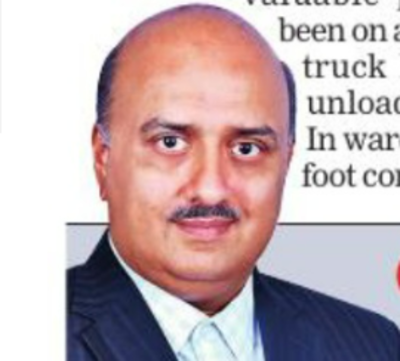
During the pandemic lockdown, as more men shared domestic workloads, Venkatesh Prasad used the extra time he had at home to design an automated glove for cleaning utensils. The glove is equipped with sensors, a soap dispenser, and a rotating power scrubber, and draws water from a bucket powered by a motor and cables.
Venkatesh says the glove ensures spotless cleaning – better than most dishwashers – optimal water usage, and reduces cleaning time by half.

Venkatesh has created over 130 products, special purpose machines, complex tooling, and fixtures, and has filed 110 global patents. He did his Bachelor’s in industrial and production engineering from BMS College in Bengaluru, and went on to do a product development course at Stanford University, US. Robotics had always piqued his interest, and early in his career, he began developing end-of-arm tools, the equipment at the end of a robotic arm that interacts with parts and components.
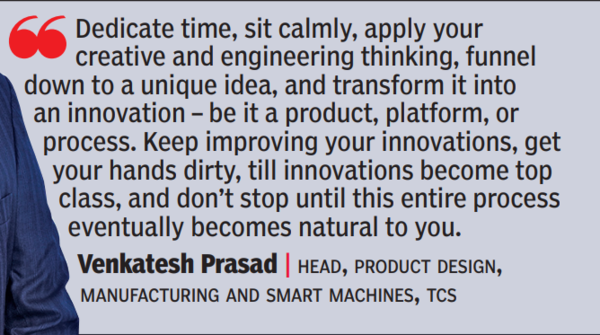
“Everyone can innovate. All it requires is a ?can do’ attitude,” says Venkatesh. When you have an idea, he says, you should be open to collaborate. “Discuss with others, don’t hesitate to take others’ views,” he says.
He suggests that you should keep working on a number of ideas. “Reflect on whether it is a success or failure. Don’t give up if there are failures early on. Failure at the beginning is a learning. An idea may ultimately end up in failure too, but that’s ok,” he says. Over time, he says, you need to mature yourself by continuous learning to a stage where you visualise ideas that will make a big impact.
“Most of my patented products are also manufactured, and it makes me happy to see them moving materials in Europe and other countries,” says Venkatesh, who, during the Covid lockdown, also created a foldable e-trike that can go inside the x-ray baggage scanner in Metro stations, potentially making commutes from home to office hassle-free.
Venkatesh says the glove ensures spotless cleaning – better than most dishwashers – optimal water usage, and reduces cleaning time by half.
His innovation wowed not only his wife, but also TCS, where Venkatesh is head of product design, manufacturing and smart machines. TCS went on to file a patent for the device.
Venkatesh has created over 130 products, special purpose machines, complex tooling, and fixtures, and has filed 110 global patents. He did his Bachelor’s in industrial and production engineering from BMS College in Bengaluru, and went on to do a product development course at Stanford University, US. Robotics had always piqued his interest, and early in his career, he began developing end-of-arm tools, the equipment at the end of a robotic arm that interacts with parts and components.
At TCS, where he’s been for more than 20 years now, one of Venkatesh’s valuable patents has been on an automated truck loading and unloading system. In warehouses, a 40-foot container truck is typically loaded with about 3,000 carton boxes, an extremely labour intensive and costly process. The TCS system has a robotic pick-and-place system in conjunction with a telescopic conveyor that is installed on telescopic rails, and all this is mounted on a mobile robot. When a truck arrives, the door opens, and this telescopic system starts loading the parcels. The system’s main advantage over rival systems is that it allows a sensor-controlled robotic arm to move inside the truck without contacting it. So, it is suitable for even small trucks with limited payload capacity and ensures an efficient and error-free process.
“Everyone can innovate. All it requires is a ?can do’ attitude,” says Venkatesh. When you have an idea, he says, you should be open to collaborate. “Discuss with others, don’t hesitate to take others’ views,” he says.
He suggests that you should keep working on a number of ideas. “Reflect on whether it is a success or failure. Don’t give up if there are failures early on. Failure at the beginning is a learning. An idea may ultimately end up in failure too, but that’s ok,” he says. Over time, he says, you need to mature yourself by continuous learning to a stage where you visualise ideas that will make a big impact.
“Most of my patented products are also manufactured, and it makes me happy to see them moving materials in Europe and other countries,” says Venkatesh, who, during the Covid lockdown, also created a foldable e-trike that can go inside the x-ray baggage scanner in Metro stations, potentially making commutes from home to office hassle-free.
End of Article
FOLLOW US ON SOCIAL MEDIA










Hot Picks
TOP TRENDING
Trending Stories
In Business
Entire Website
- Will banks open only for 5 days a week? Here’s what you should know about IBA’s proposal
- India set to be third largest economy, says S&P Global
- Dalal Street bull run continues! BSE Sensex crosses 69,000 for the first time; Nifty above 20,800
- Byju’s reduces notice period for employees as troubles mount
- Sensex surges over 900 points, Nifty above 20,550 as BJP state election wins bolster Modi's Lok Sabha 2024 prospects
- UltraTech to buy building materials business of Kesoram in 7,600 crore deal
- Tata Technologies stock debuts at a bumper 140% premium; share price at Rs 1200 on BSE
- Tata Technologies share allotment: How to check IPO allotment status, listing date, GMP
- BSE m-cap rides rally in Adani stocks, tops $4 trillion
- Charlie Munger, who helped Warren Buffett build Berkshire, dies at 99
- Harris emerges unscathed from debate, dancing around her flip-flops
- Communal violence erupts in Karnataka during Ganesha idol immersion
- iPhone success shows India can beat China to become world's factory
- After Kolkata docs set new demands, Mamata govt says 'not ready to accept'
- Assembly polls: Congress releases third list in Haryana, fourth in J&K
- 'They would be in jail if ...': Kharge's attack draws BJP's 'Emergency' retort
- Why Kolkata rape-murder victim’s mother accusing Mamata of lying?
- Apple iPhone 16 vs iPhone 15: Which iPhone to buy and why
- Not Dhoni and Rohit, Gambhir's pick for 'Shahenshah' is...
- The Multan Mystery: When Dravid left Tendulkar stranded at 194*



Popular Categories
Hot on the Web
Top Trends
Trending Topics
Deepika PadukoneMalaika Arora Father DeathArbaaz KhanJayram RaviAishwarya Rai BachchanSlat WaterWeight GainGOAT CollectionVikas Sethi DeathMalayalam ProducersIndia's Best Dancer 4Simi GarewalDilli BabuIndian National ParksLaung BenefitsVikas SethiiPhone 16Dubai Princess Sheikha MahraMG Windsor EvWordle Answer
Living and entertainment
Latest News
Manju Warrier expresses gratitude for birthday wishes: "Forever humbled and grateful"Jiiva and wife escape with minor injuries after a road accidentThe Zodiac Signs Most Naturally Inclined to HealingWhy Banyan trees survive for centuries and spread indefinitely?Telangana government pushes for increased flood relief from CentreWalking dog in Goa? Mouth guard, leash soon to be mustNBA 2K25 locker codes September 2024: Locker codes revealed and know how to reveal themDonald Trump and Kamala Harris shake hands as they meet for first time on debate stage: Watch the 'awkward' momentBRS pushes for disqualification of turncoat MLAs after High Court rulingKamala may have won debate. But election is still too close to callCommunal violence erupts in Karnataka during Ganpati Visarjan, section 144 imposedVarun Dhawan shares unfiltered reaction to Janhvi Kapoor's 'Daavudi' song from 'Devara: Part 1': 'So freaking good...''On basis of fairness and equality': Bangladesh seeks good relations with India, says YunusMpox kills two, six other confirmed cases in Cameroon: GovernmentJalen Ramsey demands action against Miami Police following Tyreek Hill's pulled from car49ers RB Christian McCaffrey misses win over JetsWWE Superstar Blames the Company for Failing to Utilize Omos’ PotentialArbaaz Khan spotted outside Malaika Arora's house along with police after the tragic news of her father's demise by alleged suicide - WATCH VIDEO
Copyright © 2024 Bennett, Coleman & Co. Ltd. All rights reserved. For reprint rights: Times Syndication Service